
Montclair Previous Residents by Era
Montclair is a Prince William County community, not an incorporated city with a separate recorder. The backward trail begins with the parcel's current county assessment card and continues through the Circuit Court Clerk's Eagle Recorder, library shelves, and older county collections. Each source dates a different event. The table distinguishes the sources so a listing, conveyance, map image, and family record are not treated as the same kind of evidence.
| Source | Years It Covers | Where Held | What It Shows |
|---|---|---|---|
| PublicAccessNow assessment card | Current card and dated transfer fields | Prince William Real Estate Assessments | Situs, GPIN, owner and mailing fields, use, assessment, and transfer leads |
| Eagle Recorder land index | 1918-present | Prince William Circuit Court Clerk | Recorded deeds, plats, parties, legal descriptions, and instrument links |
| Historical Online Portal | Pre-Revolutionary period through early 1900s | Circuit Court historical collections | Archived deeds, Wills, Lists of Heirs, and older county material |
| Prince William directory runs | 1966-71; 1973; 1975; 1977-78; 1980-current | RELIC Central Library | Dated printed names, addresses, telephone listings, and household clues |
| County Mapper aerial layers | 1937; 2004-2023 | Prince William County Mapper | Physical land, road, and building-change context |
| RELIC census and substitute records | Historic county materials, including pre-1865 substitutes | RELIC Central Library | Tax, rent, map, court, census, church, and cemetery research leads |
Use the current property card for the parcel identifier, the deed index for a conveyance, and directory or census material only for a dated household clue. That order keeps a Montclair address history grounded in the record that actually supports each conclusion.
Montclair Previous Resident Parcel Leads
Search the PublicAccessNow address form with the house number and street name. The county advises users to omit direction and suffix in the street-name field. When a result is ambiguous, County Mapper can help select the parcel, and GPIN or account number can carry the search back to the assessment card. Record the situs address separately from any mailing address, along with the GPIN, legal description, neighborhood, and transfer-history fields.
The transfer field is a lead, not the final proof. It may show a date, sale amount, owner, transfer type, and conveyance number. A transfer might be a family conveyance, trust, refinance, correction, or another non-arm's-length event rather than a move. Take the conveyance number to Eagle Recorder and verify the actual recorded instrument before assigning a date or party to the deed chain.
Note: The assessment card is a tax and valuation record; a recorded instrument is the source for a conveyance or title question.
Trace Montclair Previous Resident Deeds
Once the parcel and transfer lead are known, use Prince William Eagle Recorder. Instrument search can use a book and page or an instrument number. A name search can be limited by a date range and refined with party position, category, document type, consideration, or legal filters. Select Detail Data when available because it can expose names, legal descriptions, and marginal or related-document links that a short result view may not show.
- Open the current parcel card and copy the GPIN, precise situs address, transfer date, and conveyance number if shown.
- Find that conveyance in Eagle Recorder and capture the document type, recording date, parties, legal description, and instrument reference.
- Use the earlier purchaser or seller and the legal description to locate the preceding recorded conveyance.
- Repeat from the newest documented transfer backward, checking plats when a lot, block, or subdivision reference changes.
- When the online chain reaches its boundary, move to HOP, RELIC, or the clerk's historical research channels rather than assuming the earlier event did not exist.
- Grantor
- The party who conveys an interest in the recorded instrument.
- Grantee
- The party who receives the interest named in that instrument.
- Chain of title
- The sequence of recorded conveyances used to follow a parcel backward through ownership changes.
- Legal description
- The lot, block, subdivision, metes, or other property description in a record. It remains more stable than a street address when names or numbering change.
Montclair Previous Residents Before 1918
Eagle Recorder's online deed and related land-record index reaches 1918-present. Earlier material requires a different path. The clerk's Historical Online Portal includes archived deeds from pre-Revolutionary times through the early 1900s, plus Wills, Lists of Heirs, and the Stolen Deed Book, Liber A. Follow a documented legal description cautiously because the Montclair subdivision did not exist in those early records.
RELIC reports that many Prince William land records before 1865 were lost, and its 1731-1827 deed index is incomplete for surnames M-W. A missing hit is therefore not proof that an earlier conveyance never happened. Rent rolls, tax lists, court minutes, maps, census abstracts, and church or cemetery records are the documented substitutes. General deed indexes for 1732-1799 and 1799-1887 are available on microfilm at RELIC, subject to the collection's own holding limits.
Montclair Directories Meet Census
Montclair was established in 1969, so the directory pairing begins with the 1966-71 Prince William County series and then moves through 1973, 1975, 1977-78, and 1980-current. These volumes can produce a dated name-and-address association. A gap can reflect coverage, an unlisted telephone number, a spelling difference, a changed postal label, or a street that was not yet included. It should not be read as proof that the address was empty.
For earlier household work, RELIC provides census schedules and indexes through library research resources, including Ancestry Library Edition and HeritageQuest. Census and directory dates should be recorded side by side, rather than forced into one timeline. A directory captures a publisher's listing at publication time; a census schedule and its availability have their own rules and dates.
That pairing can place past residents in sequence without confusing a household listing with a conveyance. Preserve the publication year beside the census or library citation.
- Start with the first directory year likely to include the post-1969 street.
- Record the name, address, telephone listing, and exact publication year.
- Compare the next verified directory run for a move, spelling variation, or changed household heading.
- Use RELIC census resources to test a historical family connection where the period and legal access permit it.
- Confirm property ownership separately in the recorded deed chain.
The Montclair city directories collection has the verified year runs, collection access, and entry-reading details. The address trail uses those volumes as one layer, not as title evidence.
Montclair Previous Resident Address Checks
Address labels can mislead. The Prince William street directory includes Montclair streets with ZIP 22025 and similar street names elsewhere in the county. Search the exact street name with house number and postal/community context, then validate it against the parcel and GIS view. A historical listing that says Dumfries, Montclair, or a telephone exchange name should never be carried into a modern address record without that check.
For Montclair previous residents, this extra address check is especially important when a record predates the community name or uses a regional telephone-service label.
A plat can explain lot and subdivision changes. It can also tie the legal description in a deed to the GIS parcel. For a later change to an addition or site feature, the public Development Services ePortal can search construction and land permits, plans, inspections, code cases, and hearings by address, permit number, or project name. A public result may be only a case number or title. Underlying public records can be requested from the responsible office or through Virginia FOIA when needed.
Montclair Previous Resident Evidence Limits
County Mapper's aerial layers include 1937 and 2004, 2006, 2008, 2009, 2011, 2013, 2015, 2017, 2019, 2021, and 2023. They can help place an address in the transition from pre-community land to the later lake and subdivision landscape. ePortal can date a permit, inspection, plan, code case, or hearing. Neither aerial imagery nor an ePortal result names the people who occupied an address.
The map viewer is informational, not a legal boundary or legal description. Parcel overlays can be slightly misaligned, and lake, road, or common-area parcels can distort a quick visual reading. Use the image or permit as a date marker, then rely on an address listing, recorded instrument, or other source that actually identifies the person or documented event.
Montclair Previous Residents at RELIC
RELIC's county-records collection brings directories, maps, newspapers, county-government microfilm, yearbooks, photographs, cemetery and church material, and vital-record resources together in one research destination. Central Library is at 8601 Mathis Avenue, Manassas, VA 20110-5270, and RELIC can be reached at 703-792-8380. Published hours are Monday through Wednesday 10 a.m. to 8 p.m., Thursday and Friday 10 a.m. to 5 p.m., and the first and third Saturday 10 a.m. to 5 p.m.; confirm before visiting.
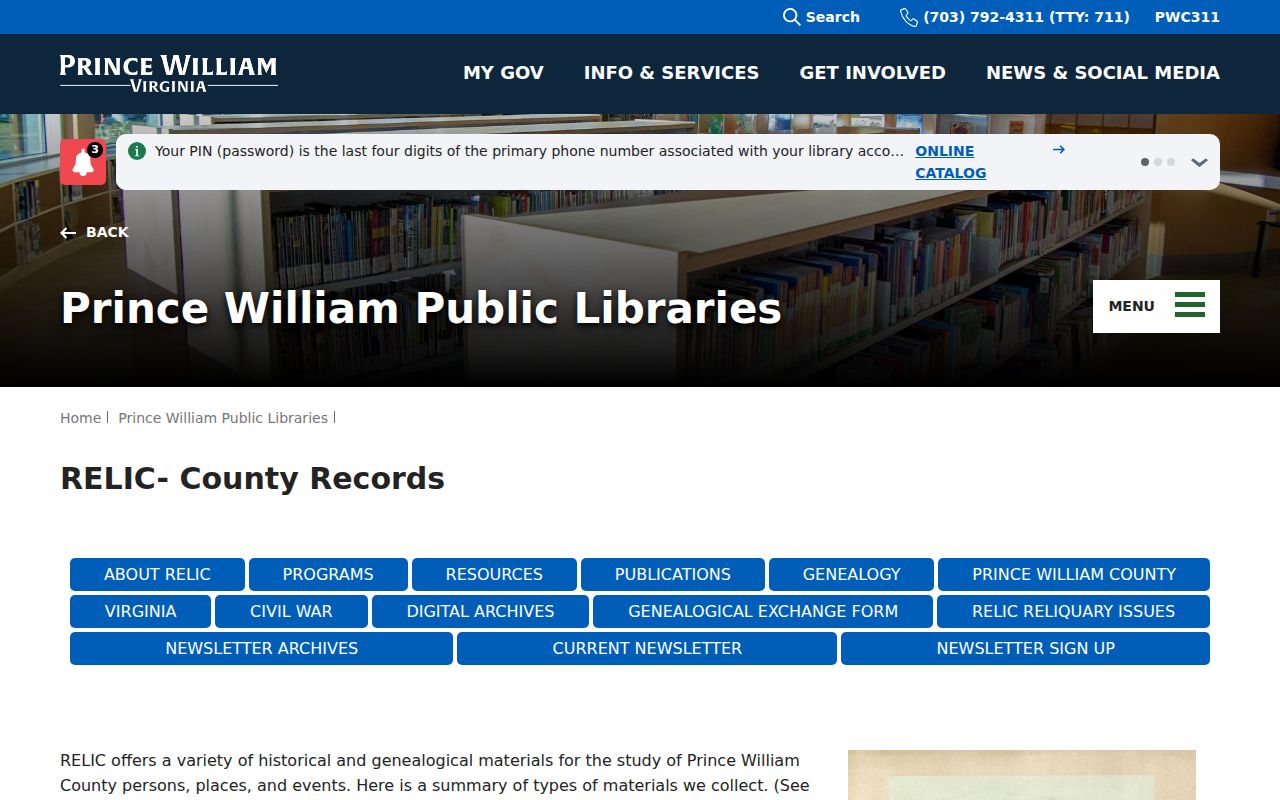
The collection helps fill a narrow gap only when the source fits the date. It also provides a place to request a physical directory or historical index rather than assuming a missing online image means the record is unavailable.
Montclair Previous Residents in Obituaries
Obituaries and county news can close a historical trail after a person leaves an address or dies. RELIC's Local News Index covers news and obituaries since 1993, with some earlier obituaries. Search a name with a street or community term, then check the cited newspaper image or issue. Probate and Lists of Heirs can add family relationship leads, but each record should be interpreted on its own date and purpose.
The Virginia vital-record forms show the official request channels for birth, death, marriage, divorce, stillbirth, and amendment records. Virginia makes death, marriage, and divorce information public after 25 years and birth information after 100 years; otherwise eligibility and identification rules apply. A current certificate request is not a substitute for a directory or deed, but the state records can help confirm a historical life event when access rules allow.
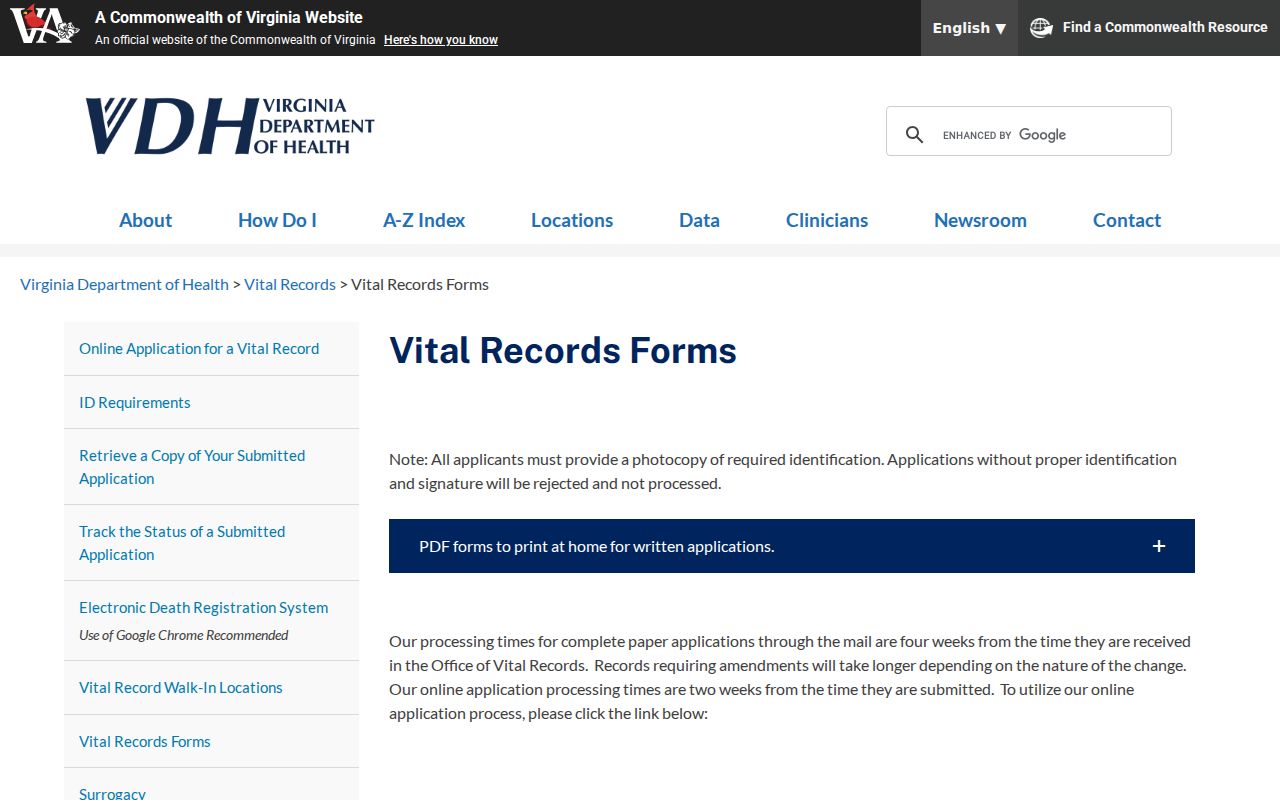
The forms screen identifies the official route. It does not expose a public list of Montclair residents, and a request should be limited to a lawful family-history or estate question.
Lawful Montclair Address Research
A previous-resident search is most useful for family history, estate or heir work, a documented property chronology, and reconnecting with a past community story. It should stay narrow: keep the address, date, record type, and source together, and do not turn one historical listing into a claim about a living person. The Virginia Address Confidentiality Program and protective-order protections can limit address information in appropriate records.
Lawful use. Use Montclair address history for personal, family, estate, or property research. Do not use information from a record to stalk, harass, track, or harm a living person.
Virginia FOIA can be a path to an existing public county record when a portal result is incomplete, but a request should identify the document or case precisely. The law does not turn protected or restricted material into public information.
Montclair Previous Resident Myth
The assessment transfer line is not a complete resident list. It is only a pointer to a recorded event, and the named owner may not have occupied the address. Likewise, an old directory listing proves a dated printed association, not a deed or current residence. The reliable method is to preserve the limits of every source and confirm the conveyance in Eagle Recorder.
A useful insider practice is to copy the conveyance number from the assessment transfer field before leaving the parcel card. That number can shorten the Eagle Recorder search and keeps the parcel history tied to the actual recorded instrument. For future changes after a parcel is identified, the county's 2025 Property Alert system can notify an owner by name or GPIN, while its separate document search has a limited recent time window.